

Introduction
Remote work has changed significantly over the past few years.
Video meetings became one of the easiest ways for distributed teams to communicate, and platforms such as Zoom helped make face-to-face conversations possible even when employees were working from different locations.
But the future of remote work is unlikely to be built around video meetings alone.
The next stage of digital work is moving toward a broader combination of AI, asynchronous communication, automation, virtual collaboration, digital workspaces, and intelligent workflows.
Microsoft Research describes AI as part of a broader evolution in collaboration, with increasing attention on helping people work together rather than simply helping individuals complete tasks faster.
So, what comes after the traditional video meeting?
Let’s explore the technologies and ideas that could shape the next generation of remote work.
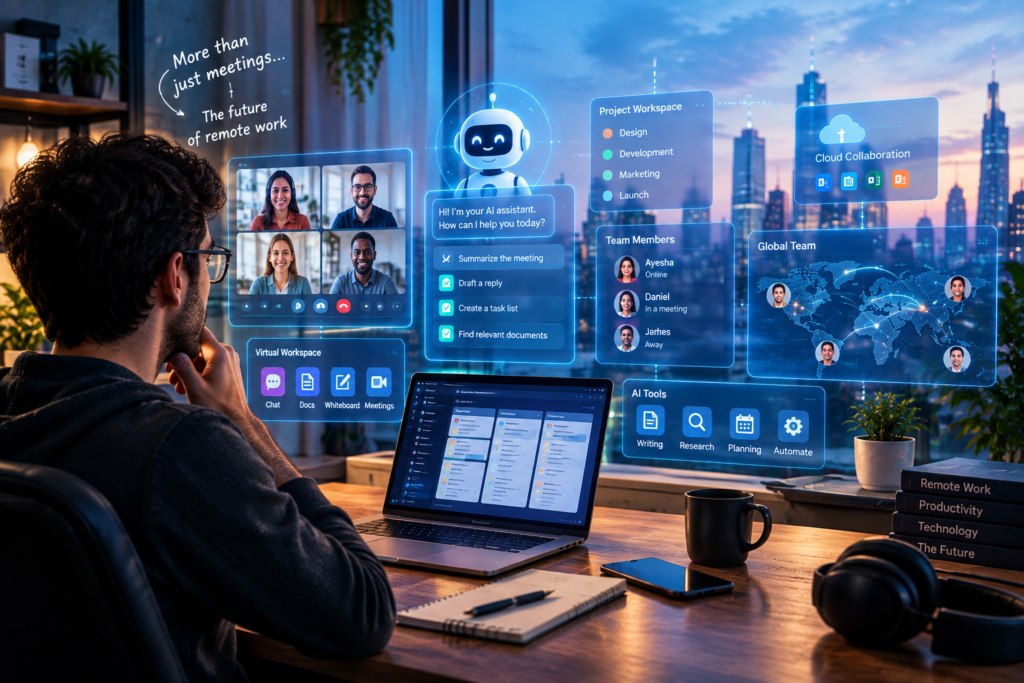
1. Remote Work Is Becoming More Than Video Calls
Video conferencing solved an important problem: people could see and talk to each other without being in the same room.
But not every task requires a meeting.
A designer reviewing a project, a developer fixing a bug, or a writer editing an article may not need a 30-minute video call to complete the work.
This is why modern remote teams are increasingly combining meetings with other forms of communication.
Instead of asking:
“When can everyone meet?”
teams can increasingly ask:
“What is the most efficient way to move this work forward?”
That shift can reduce unnecessary meetings and give employees more time for focused work.
Future of Remote Work
2. Asynchronous Work Could Become More Important
Asynchronous work means people don’t have to respond or participate at exactly the same time.
For distributed teams, this can be particularly useful when employees work across different cities, countries, or time zones.
For example, instead of holding a meeting to explain a project update, a team member could provide:
- A written update
- A short recorded explanation
- Relevant documents
- Project links
- Clear action items
Other team members can review the information when they are available.
This approach can make collaboration more flexible.
It can also create a written record that people can return to later.
Future of Remote Work
3. AI Could Become a Remote Teammate
One of the biggest changes to remote work may come from artificial intelligence.
AI is increasingly moving beyond simple text generation toward systems that can help with multi-step tasks and workflows.
Microsoft describes this shift as AI becoming more deeply involved in how organizations get work done, while its research also highlights AI’s potential role in improving collaboration.
Future of Remote Work team could use AI to help with tasks such as:
- Meeting summaries
- Research
- Scheduling
- Project updates
- Document preparation
- Data analysis
- Customer communication
- Task management
- Follow-up reminders
The important change is that AI may increasingly connect information across different parts of the workflow rather than simply answering individual questions.
Future of Remote Work
4. AI Agents Could Handle Repetitive Work
Traditional software generally waits for a person to tell it what to do.
AI agents are designed to handle more complex sequences of tasks based on a goal.
For example, imagine telling an AI system:
“Prepare the weekly project update.”
A system could potentially gather information from project-management tools, summarize completed work, identify outstanding tasks, prepare a draft update, and send it to a human for review.
This does not mean every workplace task will become fully automated.
Human oversight will remain important, particularly for decisions involving sensitive information, customers, finances, security, or business strategy.
But automation could reduce the amount of repetitive administrative work remote employees have to perform.
Microsoft and Zoom have both described current developments moving AI toward more active participation in workplace workflows.
Future of Remote Work
5. Virtual Workspaces Could Replace Some Meeting Rooms
The traditional office has physical spaces for meetings, brainstorming, project discussions, and presentations.
Remote teams need digital equivalents.
Modern collaboration platforms are already moving beyond simple video calls toward integrated spaces for documents, chat, project information, and other work.
Future virtual workspaces could combine:
- Video communication
- Team chat
- Documents
- Whiteboards
- Project management
- AI assistants
- Data dashboards
- File sharing
- Task automation
Instead of opening multiple disconnected applications, employees could increasingly work from a connected digital environment.
Future of Remote Work
6. Meetings May Become More Intelligent
The future of remote work doesn’t necessarily mean eliminating meetings.
It may mean making them more useful.
AI can already assist with tasks such as transcription and summarization, while newer workplace systems are moving toward connecting conversations with documents and follow-up actions.
A more intelligent meeting workflow could look like this:
Before the Meeting
AI prepares an agenda using relevant project information.
During the Meeting
The system captures important points and identifies decisions.
After the Meeting
AI creates a summary and organizes action items.
Following Days
The system reminds team members about outstanding tasks.
The goal is simple:
Less time managing the meeting, more time acting on what was discussed.
Future of Remote Work
7. Hybrid Work Will Continue to Evolve
Remote work and office work don’t necessarily have to be competing models.
Many organizations are experimenting with hybrid approaches that combine remote and in-person work.
Zoom’s 2026 research describes hybrid work as an evolving model and reports that organizations are continuing to explore more flexible workplace arrangements.
A future workplace could allow employees to choose the most appropriate environment for different types of work.
For example:
Focused work → Home
Team brainstorming → Office
Client meeting → Virtual or office
Deep technical work → Flexible location
The right model can depend on the type of work rather than a single rule for everyone.
Future of Remote Work
8. Digital Workplaces Could Become More Personalized
The future digital workplace may adapt to the employee rather than forcing everyone to use the same workflow.
AI-powered systems could potentially understand:
- Current tasks
- Deadlines
- Meetings
- Project priorities
- Communication preferences
- Frequently used information
An employee could start the day with a personalized workspace showing the most important tasks and relevant information.
Instead of searching through dozens of applications, employees could have a single intelligent interface that helps them find what they need.
Future of Remote Work
9. Remote Collaboration Will Become More Global
One major advantage of remote work is that companies can collaborate across geographic boundaries.
A team could include people from several cities or countries.
Future collaboration technology may reduce some of the barriers created by:
- Time zones
- Language differences
- Communication styles
- Different working schedules
AI-assisted translation, transcription, summarization, and context management could make international collaboration easier.
Microsoft Research has specifically highlighted time zones, languages, and scale as areas where AI could help address collaboration challenges.
Future of Remote Work
10. Virtual Reality Could Change Online Meetings
Video meetings keep people inside rectangular windows on a screen.
Virtual and augmented reality could create a different type of digital interaction.
Instead of seeing six small video boxes, employees could potentially meet inside a shared virtual environment.
Possible applications include:
- Virtual offices
- 3D presentations
- Product demonstrations
- Training
- Design reviews
- Virtual conferences
- Interactive education
This technology still has practical limitations, including hardware costs, comfort, accessibility, and user adoption.
For that reason, immersive workplaces are more likely to complement existing tools than immediately replace them.
Future of Remote Work
11. The Digital Office May Become More Connected
One of the biggest problems with remote work is fragmented information.
A team may use one application for chat, another for documents, another for project management, another for meetings, and several others for specialized tasks.
When these systems don’t communicate effectively, employees become the connection between them.
Microsoft has highlighted this problem as a source of friction in hybrid work and points toward connected workflows and AI automation as potential ways to reduce manual work between systems.
The future digital workplace may therefore focus heavily on integration.
Future of Remote Work
12. Cybersecurity Will Become Even More Important
A more connected remote workplace also creates additional security considerations.
Employees may access company information from:
- Home networks
- Personal devices
- Public locations
- Cloud applications
- Mobile phones
- Collaboration platforms
Organizations will need strong security practices to protect sensitive information.
Important areas include:
- Multi-factor authentication
- Secure devices
- Identity management
- Data protection
- Employee security training
- Access controls
- Phishing awareness
- Secure cloud systems
The more work moves into digital environments, the more important cybersecurity becomes.
Future of Remote Work
13. Human Skills Will Still Matter
It would be easy to assume that the future of remote work is mainly about technology.
It isn’t.
Technology can help people communicate and automate tasks, but human skills remain important.
Remote professionals will still need:
- Communication
- Creativity
- Critical thinking
- Leadership
- Problem-solving
- Collaboration
- Emotional awareness
- Decision-making
AI may handle more repetitive activities, but people will still need to determine what should be done and why.
Gartner’s September 2026 research describes the emerging human-AI relationship in terms of expanding human capability while maintaining accountability.
Future of Remote Work
14. The Future May Be “Work From Anywhere, Collaborate Everywhere”
The phrase “work from home” may eventually feel too narrow.
The future workplace could be more flexible.
A professional might work:
- From home
- From a coworking space
- From an office
- While traveling
- From another city
- Across multiple time zones
What matters most may become access to the right information, tools, people, and systems rather than a particular physical location.
This could create a more flexible definition of the workplace.
Future of Remote Work
What Comes After Zoom?
The answer probably isn’t one single application.
The next stage of remote work is more likely to be an ecosystem of connected technologies.
Imagine:
AI + Video + Chat + Documents + Automation + Virtual Workspaces + Cloud Computing
working together.
A video meeting could produce a summary.
The summary could create tasks.
AI could help complete some of those tasks.
The finished work could automatically appear in the relevant project workspace.
The employee then reviews the result and makes the final decisions.
That is a very different workflow from simply joining a video call.
Future of Remote Work
Challenges of the Future Remote Workplace
Technology can solve some problems, but it can also create new ones.
Too Much Automation
Employees may become overwhelmed by automated notifications and AI-generated information.
Privacy Concerns
Workplace AI systems may process sensitive company and employee information.
Digital Fatigue
Constant connectivity can make it difficult to separate work from personal life.
Security Risks
More connected systems can create more opportunities for cyberattacks.
Loss of Human Connection
Digital communication cannot completely replace every benefit of face-to-face interaction.
Unequal Access
Not every employee has the same internet connection, hardware, workspace, or technical resources.
The future of remote work will therefore depend on both technology and thoughtful workplace design.
Future of Remote Work
How Businesses Can Prepare
Companies preparing for the future of remote work can start with practical improvements rather than waiting for futuristic technology.
1. Reduce Unnecessary Meetings
Use written updates and asynchronous communication when a meeting isn’t necessary.
2. Connect Digital Tools
Reduce unnecessary switching between disconnected applications.
3. Introduce AI Carefully
Use AI where it solves a genuine workflow problem.
4. Improve Cybersecurity
Protect employee accounts, devices, and company data.
5. Train Employees
Technology is only useful when employees know how to use it effectively.
6. Measure Outcomes
Focus on completed work and business outcomes rather than simply tracking online activity.
7. Keep Humans in the Loop
Important decisions should have appropriate human review and accountability.
Future of Remote Work
The Future of Remote Work: Final Thoughts
The future of remote work is unlikely to be defined by one video-conferencing platform.
Instead, the workplace is moving toward a more connected environment where AI, automation, asynchronous communication, cloud services, digital collaboration, and human expertise work together.
Video meetings will probably remain useful, especially when people need real-time conversation and human connection.
But they may become only one part of a much larger digital workplace.
The biggest change may be the shift from “Where are you working?” to “How can technology help you do meaningful work more effectively?”
For Future Stack readers, one thing is clear: learning how to work alongside AI and modern digital tools could become just as important as learning how to use a video meeting platform.
The remote workplace of tomorrow may not simply be virtual.
It may be intelligent, connected, flexible, and increasingly collaborative.
Future of Remote Work
Frequently Asked Questions
What is the future of remote work?
The future of remote work is likely to involve a combination of remote and hybrid work, AI-assisted collaboration, automation, asynchronous communication, cloud services, and connected digital workplaces.
Will Zoom disappear?
There is no basis for saying that Zoom will disappear. Video communication remains useful, but future workplaces may rely on a wider range of technologies alongside video meetings.
Will AI replace remote workers?
AI can automate certain tasks, but its impact will vary by role and industry. Many jobs involve human judgment, communication, creativity, responsibility, and decision-making.
What technology will shape remote work?
AI, automation, cloud computing, collaboration platforms, cybersecurity, virtual workspaces, and immersive technologies are among the areas likely to influence remote work.
Is hybrid work the future?
Hybrid work is one important model being used by organizations, but workplace arrangements vary by industry, role, geography, and company. Current research shows continued experimentation with flexible models.
Future of Remote Work
10 Cybersecurity Habits Everyone Should Follow