
Introduction
AI Agents in 2026
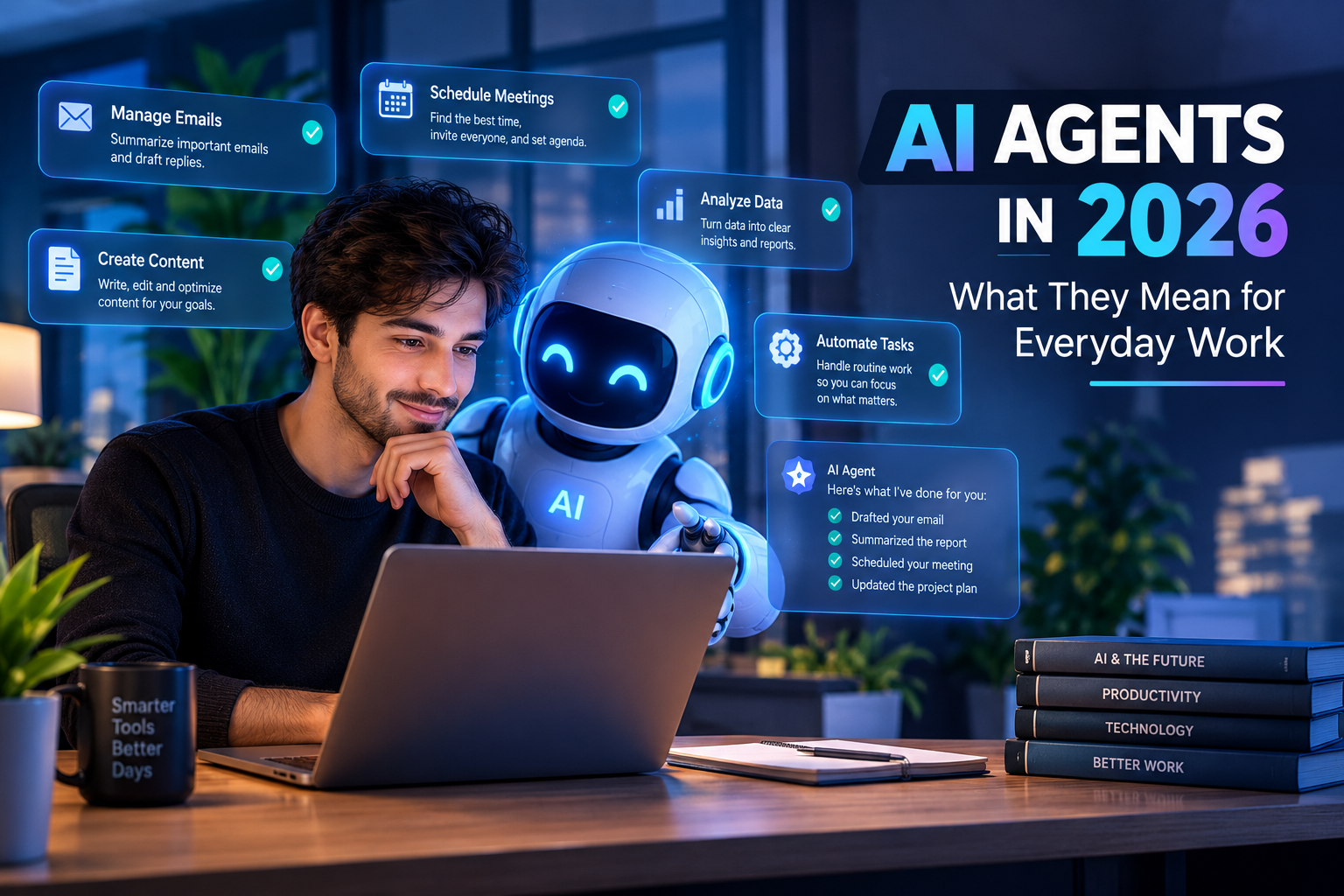
AI assistants are becoming more capable of doing work instead of simply explaining how to do it. In 2026, the important shift is from the chatbot era to the agent era: systems can interpret a goal, plan several steps, use software, retrieve information, and return an outcome. Google Cloud describes AI agents as systems that can understand goals, develop multi-step plans, and take actions under human guidance, while Microsoft’s 2026 Work Trend Index describes growing human-agent collaboration.
AI agents in 2026
What Is an AI Agent?
A traditional chatbot mainly responds to a prompt. An AI agent is designed around a goal and a workflow. Depending on its permissions, it may search information, organize files, update a system, draft messages, analyze data, or coordinate several tools. The key difference is action: the software is not only generating text; it is participating in a process.
AI agents in 2026
Why 2026 Is Different
The technology stack around AI agents is becoming more mature. Companies are experimenting with multi-agent workflows, AI-native development platforms, domain-specific models, and AI security systems. Gartner’s 2026 strategic technology trends specifically include multiagent systems, AI-native development platforms, domain-specific language models, and AI security platforms.
AI agents in 2026
Where Agents Can Help
For a small business, an agent might summarize customer requests, prepare a sales brief, classify incoming leads, or create a first draft of a weekly report. A marketing team could use agents to collect campaign data, identify unusual changes, and prepare recommendations for human review. Developers can use agentic systems to inspect documentation, generate code, run tests, and organize issues. These workflows can reduce repetitive work without removing the need for human judgment.
AI agents in 2026
The Human Role Still Matters
More automation does not automatically mean less responsibility. When an agent can take actions, the user needs to understand what the system is allowed to access and what decisions still require approval. Microsoft’s research emphasizes human agency as AI and agents take on more execution, while security researchers are increasingly focused on observability, governance, and permissions.
AI agents in 2026
How to Start Safely
Start with a narrow workflow. Define the goal, list the tools the agent needs, restrict permissions, create approval checkpoints, and test the workflow with non-sensitive data. Keep logs so a person can review what happened. A useful rule is simple: give an agent only the access required for its job.
AI agents in 2026
What This Means for Workers
The most valuable skill may increasingly be the ability to direct, check, and improve AI-powered workflows. That includes writing clear instructions, evaluating outputs, understanding data quality, and knowing when automation should stop. Workers who combine domain expertise with AI workflow skills can use agents as leverage rather than treating them as a replacement for judgment.
AI agents in 2026
Conclusion
AI agents are becoming a practical layer between people and software. The biggest opportunity is not to automate everything; it is to remove repetitive steps while keeping people responsible for important decisions. In 2026, learning how to design, supervise, and secure agentic workflows is becoming an important digital skill.
AI agents in 2026
Frequently Asked Questions
Are AI agents the same as chatbots?
No. Chatbots primarily respond to requests, while agents can be designed to plan and execute multi-step tasks using connected tools.
AI agents in 2026
Can small businesses use AI agents?
Yes. Small businesses can start with narrow tasks such as research, document preparation, customer triage, or reporting.
AI agents in 2026
Should an AI agent have full access to my accounts?
Usually no. Permissions should be limited to what the workflow actually requires.
Will AI agents replace every job?
No single outcome is guaranteed. Their effect will vary by occupation, workflow, skills, and how organizations deploy them.
AI agents in 2026
What should beginners learn first?
Start with AI fundamentals, workflow design, prompt/instruction writing, data privacy, and output verification.
AI agents in 2026
Suggested CTA
Subscribe to FutureStack for practical guides on AI, cybersecurity, software, productivity, and the technologies shaping the next generation of the internet.
AI agents in 2026
Research References
Google Cloud — 2026 AI Agent Trends Report
Microsoft — 2026 Work Trend Index
Gartner — Top Strategic Technology Trends for 2026
AI agents in 2026
The Powerful Rise of AI-Powered Search: What Website Owners Need to Knowhttps://futurestack.blog/the-powerful-rise-of-ai-powered-search-what-website-owners-need-to-know/
AI agents in 2026