

Introduction
The internet was built around information.
People publish articles, upload photographs, create videos, share documents, post social media updates, and distribute software to audiences around the world.
For much of the internet’s history, people could often make a reasonable assumption about digital content:
Someone created this file, uploaded it, and it represents something that happened.
That assumption is becoming harder to make.
Modern artificial intelligence can generate realistic photographs, videos, voices, documents, illustrations, and written content within seconds. Existing material can also be edited, transformed, compressed, translated, or combined with other content.
As a result, a new question is becoming increasingly important:
digital provenance
Where did this digital content come from?
That question is at the heart of digital provenance.
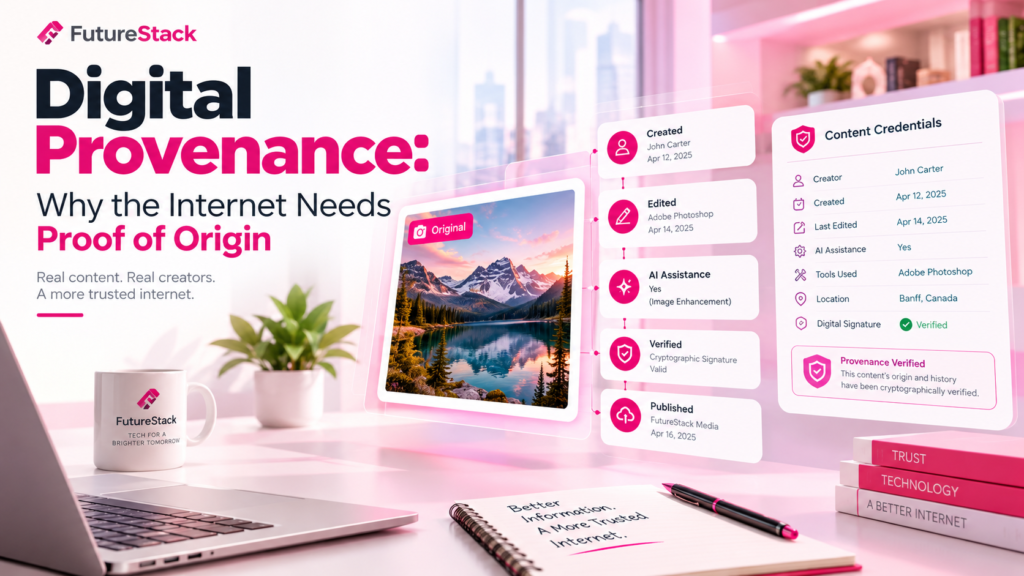
Digital provenance is about recording and communicating information about the origin and history of digital content. It can help people understand who created something, where it came from, what happened to it, and whether it has been modified.
Provenance cannot guarantee that information is true.
But it can provide valuable context.
In an internet increasingly filled with AI-generated and digitally modified content, that context could become one of the most important building blocks of online trust.
digital provenance
What Is Digital Provenance?
Digital provenance refers to information about the origin, history, ownership, and transformation of a digital asset.
Think about a photograph.
Without provenance, you might see an image online and know only that someone uploaded it.
With provenance information, you could potentially learn:
- Who originally created the image
- When it was created
- Which device or software produced it
- Whether it was edited
- Which tools were used to edit it
- Whether AI was involved
- Who published it
- Whether additional changes were made
The same concept can apply to:
- Photographs
- Videos
- Audio
- Documents
- Articles
- Graphics
- Software
- Datasets
- Digital artwork
- Scientific information
- Business documents
In simple terms:
Digital provenance is the history of a digital object.
digital provenance
Why Digital Provenance Matters Now
Digital provenance is not a completely new idea.
Photographers, journalists, publishers, archivists, and businesses have always maintained records about their work.
What has changed is the scale and speed of digital creation.
AI has dramatically lowered the cost of creating convincing digital material.
A person can now generate:
- A realistic person who never existed
- A synthetic news-style video
- An artificial voice
- A fictional photograph
- A computer-generated product image
- An AI-written article
- A modified version of a real photograph
The technology itself is not automatically good or bad.
The challenge is knowing what we are looking at.
Imagine seeing a photograph of an important event online.
There are several possibilities:
- It is an authentic photograph.
- It is an authentic photograph that has been edited.
- It is a completely AI-generated image.
- It combines real and synthetic elements.
- It is an old photograph being presented as a new event.
The visual appearance alone may not answer these questions.
That is where provenance can help.
digital provenance
Digital Provenance Is Not the Same as Fact-Checking
This distinction is extremely important.
Provenance tells us about the history of content.
Fact-checking evaluates the truth of claims.
These are related, but they are not identical.
Imagine an article that has excellent provenance.
You may know:
- Who wrote it
- When it was written
- Which sources were used
- How it was edited
- Where it was published
But the article could still contain incorrect information.
Likewise, a photograph could have a clear creation history but still be misleading because it is being presented without the correct context.
Therefore:
Provenance does not equal truth.
Instead, provenance gives users additional information that can help them evaluate content.
A healthy information system needs both.
digital provenance
The Difference Between Provenance and Authenticity
The terms “provenance” and “authenticity” are sometimes used together, but they describe different ideas.
Provenance
Provenance focuses on:
Where did this content come from?
Authenticity
Authenticity focuses more broadly on:
Is this what it claims to be?
For example, provenance might tell you that a photograph was created by a particular camera at a particular time.
Authenticity involves the larger question of whether the photograph accurately represents the event being discussed.
This difference matters because even a genuine photograph can be misleading.
A real image can be:
- Cropped
- Taken out of context
- Reused with a false description
- Presented as a different event
- Edited in ways that change its meaning
Provenance provides evidence about the content’s history.
Context and verification are still necessary.
digital provenance
How Digital Provenance Can Work
Digital provenance can be implemented in different ways.
At a high level, a provenance system can attach information to a digital asset describing its history.
For example:
Original Creation
↓
Editing
↓
AI Enhancement
↓
Export
↓
Publication
↓
Further Modification
This creates a kind of digital history.
Modern provenance systems can use cryptographic techniques to help make records tamper-evident.
Instead of relying entirely on a simple statement such as:
“This image is original.”
a system can provide structured information describing how the asset was created or modified.
That information can potentially be inspected by compatible software.
digital provenance
Cryptography and Digital Provenance
Cryptography plays an important role in many modern approaches to digital provenance.
One common concept is a digital signature.
A digital signature can help establish that information was associated with a particular identity or key and that the signed information has not been altered without detection.
This can create a stronger relationship between:
Content + Identity + History
For example, a camera or software application could create signed information associated with an image.
Later, compatible systems could use that information to determine whether the recorded provenance data has been altered.
This does not magically prove that every claim about the content is true.
Instead, cryptography can make provenance records more trustworthy and resistant to unnoticed modification.
digital provenance
What Is Content Credentials?
One of the major ideas associated with digital content provenance is content credentials.
Content credentials can provide information about how digital media was created or modified.
For example, a supported image may contain information indicating:
- The creator
- The creation process
- Editing activity
- AI involvement
- Software used
- Previous versions
The goal is to provide users with additional context.
Instead of asking only:
“Does this image look real?”
people can potentially ask:
“What information is available about this image’s creation history?”
This is a significant shift.
digital provenance
Why AI-Generated Content Makes Provenance More Important
Generative AI creates a unique challenge because the final output can look completely different from its underlying process.
A traditional photograph might have a relatively straightforward origin:
Camera → Photograph → Edit → Publish
AI-generated content can have a more complicated process:
Prompt → AI model → Generated image → Editing → Upscaling → Publication
Or:
Real photograph → AI modification → Human editing → Publication
Without additional information, it may be difficult for an ordinary viewer to understand the difference.
Provenance can potentially make this process more transparent.
AI Disclosure and Transparency
Imagine visiting a website and seeing a beautiful photograph.
A small indicator tells you:
Created with generative AI
That information does not automatically tell you whether the image is good or bad.
It simply gives you context.
Similarly, a video could indicate:
Original recording with AI-assisted editing
A document could indicate:
Human-written with AI-assisted revisions
The objective is not necessarily to prevent AI-generated content.
The objective is transparency.
People should have more information about what they are consuming.
digital provenance
Why Publishers Need Digital Provenance
Publishers have a particularly important role in the future of online trust.
News websites, blogs, magazines, research platforms, and information websites can benefit from transparent content practices.
A publisher can improve trust by clearly identifying:
- Authors
- Publication dates
- Updated dates
- Sources
- Corrections
- Original reporting
- AI assistance
- Editorial processes
For a technology website such as FutureStack, this can become part of a broader editorial strategy.
Instead of simply publishing information, a website can show readers:
Where did this information come from?
That question can become increasingly valuable.
digital provenance
Digital Provenance for Bloggers
Bloggers can also use provenance principles.
You do not need a complicated technical system to start.
Simple practices can make your content more transparent.
For example:
Identify the Author
Show who wrote the article.
Add Publication Dates
Tell readers when the article was originally published.
Show Update Dates
If significant changes are made, show when the article was updated.
Cite Sources
Link claims to reliable sources.
Explain Original Research
If you conducted your own test or analysis, explain how.
Identify AI Assistance
When appropriate, explain whether AI was used to assist with writing, images, research, or editing.
Keep Original Files
Maintain original documents, photographs, research notes, and source material.
These practices create a basic form of editorial provenance.
digital provenance
Why Original Images Matter
Images are particularly important in the AI era.
A website can strengthen transparency by maintaining records of:
- Original image files
- Creation dates
- Editing history
- Photographer or creator
- Licensing information
- AI involvement
- Source information
For example, a technology blog might publish an original illustration and document:
Created: September 2026
Creator: FutureStack
Type: Original digital illustration
AI assistance: Disclosed if applicable
Edits: Cropping and website optimization
This gives readers more context than a random image copied from another website.
Digital Provenance and Copyright
Provenance can also be useful for copyright management.
Creators frequently face problems such as:
- Unauthorized copying
- Unclear ownership
- Missing attribution
- Reused images
- Modified artwork
- Content reposting
A provenance record can help establish information about an asset’s history.
For example:
Creator → Original File → Publication → Licensed Use → Modification
This does not automatically solve copyright disputes.
Legal ownership depends on applicable law, agreements, licenses, and other circumstances.
But better records can make ownership and creation history easier to understand.
digital provenance
Provenance for Video
Video presents an even bigger challenge.
Modern editing software can change:
- Faces
- Voices
- Backgrounds
- Lighting
- Dialogue
- Objects
- Locations
AI can also generate entirely synthetic video.
This means viewers may eventually need more information than a simple “video uploaded by user” label.
A provenance system could potentially describe:
- Original recording
- Editing software
- AI-generated sections
- Audio modifications
- Visual changes
- Export history
This could be especially valuable for journalism, education, advertising, and documentary content.
digital provenance
Provenance for Audio
Voice cloning is another important area.
AI systems can create convincing synthetic speech.
That creates risks involving:
- Fake interviews
- Impersonation
- Fraud
- Misleading recordings
- Fake endorsements
- Manipulated conversations
Provenance can help communicate whether audio originated from a recording, was edited, or involved synthetic generation.
Again, provenance does not prove that the spoken claims are true.
It simply gives people more information about the recording’s history.
digital provenance
Digital Provenance and Journalism
Journalism may become one of the most important areas for provenance technology.
Imagine a breaking-news photograph.
A newsroom could potentially provide information about:
- The original photographer
- Capture time
- Capture location when appropriate
- Editing history
- Publication history
- Verification steps
Readers would gain more context about the image.
This could be especially valuable during major events when misinformation spreads quickly.
However, provenance should complement—not replace—journalistic verification.
Journalists still need to investigate:
- Who took the image
- What happened
- Where it happened
- When it happened
- Whether the description is accurate
- Whether the source is trustworthy
- digital provenance
Digital Provenance and Social Media
Social platforms distribute content at enormous speed.
A photograph posted in one country can reach millions of people within hours.
During that process, content can be:
- Downloaded
- Re-uploaded
- Cropped
- Screenshotted
- Edited
- Reposted
- Combined with other content
This can break the connection between content and its original source.
Provenance systems could help preserve some of that history.
Imagine seeing a social-media image with an expandable history:
Original creator
↓
Published
↓
Edited
↓
Reposted
↓
Current version
That would provide users with more context.
The challenge is making such systems easy enough for ordinary people to understand.
The Problem With Screenshots
Screenshots are one of the simplest ways provenance can be lost.
Imagine a photograph contains useful metadata.
Someone takes a screenshot.
The screenshot becomes a new file.
The original metadata may no longer be attached.
The screenshot is uploaded to social media.
Another person downloads it.
They edit it.
Someone else reposts it.
Eventually, the connection to the original source can disappear.
This illustrates an important challenge:
Provenance must survive the movement of content across platforms.
If every platform uses a completely different system, maintaining a reliable history becomes much harder.
Interoperability Is Critical
For provenance to become useful across the internet, different systems need ways to communicate.
Imagine:
Camera A
creates content.
Then:
Editing Software B
modifies it.
Then:
Platform C
publishes it.
Then:
Social Network D
distributes it.
If each system uses incompatible provenance information, the history can become fragmented.
Interoperability allows provenance information to move with content across different environments.
This is one reason common standards and open approaches are important.
Digital Provenance Does Not Mean Surveillance
Some people may worry that provenance systems could create unnecessary tracking.
That concern deserves consideration.
A provenance system should not automatically reveal every piece of private information about a creator.
For example, the public may not need to know:
- A photographer’s exact private location
- Private device information
- Personal identifiers
- Sensitive editing history
A useful provenance system needs to balance:
Transparency + Privacy
The goal should be to provide meaningful information without exposing unnecessary personal data.
The Risk of False Confidence
Digital provenance can improve trust, but it can also create a new problem:
People may trust provenance too much.
Imagine an image contains a verified creation history.
A viewer might assume:
“This must be true.”
That conclusion could be incorrect.
The provenance may be accurate while the accompanying description is misleading.
For example:
A real photograph from 2018 could be presented as an image from 2026.
The photograph itself may have excellent provenance.
The claim about the photograph could still be false.
Therefore, provenance should be treated as evidence about origin, not a universal truth certificate.
Can Digital Provenance Stop Deepfakes?
Not completely.
This is another important distinction.
Provenance can help establish information about legitimate content.
But not every piece of content will contain trustworthy provenance.
A malicious creator can generate content without provenance.
Someone can also remove metadata or distribute content through systems that do not preserve provenance information.
Therefore, provenance is one tool in a broader ecosystem that can include:
- Fact-checking
- Media literacy
- Digital signatures
- Platform policies
- Identity verification
- Secure infrastructure
- Human investigation
- AI detection techniques
- Editorial standards
No single technology can solve every misinformation problem.
Why Users Need Media Literacy Too
Technology alone cannot create an informed internet.
Users need to learn how to evaluate information.
A digitally literate user should ask:
- Who created this?
- Where did it come from?
- When was it created?
- Has it been edited?
- What evidence supports the claim?
- Is the source credible?
- Could the content be misleading?
- Is the context complete?
Digital provenance can make some of these questions easier to answer.
But people still need the habit of asking them.
Digital Provenance in Business
Businesses can benefit from provenance beyond public media.
Consider a company working with thousands of documents.
Employees may need to know:
- Who created a document
- Who approved it
- Which version is current
- What changes were made
- Which data sources were used
This is essentially provenance.
It can help with:
- Compliance
- Auditing
- Quality control
- Intellectual property
- Security
- Collaboration
- Document management
As businesses increasingly use AI to generate and transform information, keeping track of content history can become even more important.
Provenance in Software Development
Software also has a history.
A software project may include:
Human-written code
↓
AI-assisted code
↓
Automated testing
↓
Code review
↓
Build
↓
Deployment
Knowing where code originated can be useful for security and software supply-chain management.
Developers may increasingly want to know:
- Which developer created a change?
- Which AI tool assisted?
- Which dependencies were used?
- Which tests were executed?
- Which version was deployed?
This is another form of digital provenance.
Provenance in Scientific Research
Scientific research depends heavily on trustworthy information.
Researchers need to understand:
- Where datasets came from
- How data was collected
- How it was cleaned
- Which transformations were performed
- Which models were used
- How results were generated
AI makes this even more important.
If an AI system analyzes a dataset, researchers may want a record of:
Data → Processing → Model → Analysis → Result
This can improve reproducibility and transparency.
The Future of Digital Provenance
Digital provenance could become a normal part of the internet’s infrastructure.
Instead of provenance being something only experts think about, users may eventually see simple indicators such as:
Original Source
AI-Assisted
Edited
Verified Creator
Creation History Available
The technical infrastructure behind these indicators could be complex.
The user experience should be simple.
People should not need to understand cryptographic signatures or metadata formats to understand basic content history.
What Website Owners Can Do Today
You do not need to wait for the future to improve content provenance.
Website owners can start with simple steps.
1. Publish Original Content
Create your own research, explanations, images, and analysis.
2. Identify Authors
Make it clear who created the content.
3. Cite Sources
Give readers a path to the information behind important claims.
4. Keep Original Files
Store source documents, images, research notes, and other original materials.
5. Document Updates
When an article changes significantly, record the update date.
6. Disclose AI Assistance
Be transparent about meaningful AI involvement when appropriate.
7. Maintain Copyright Records
Keep track of ownership and licenses for external assets.
8. Preserve Context
Do not publish images or quotations without explaining what they represent.
These steps can create a stronger culture of transparency.
A Simple Digital Provenance Framework for FutureStack
For a technology website such as FutureStack, a simple internal framework could look like this:
Article
Title: Digital Provenance: Why the Internet Needs Proof of Origin
Author: FutureStack Editorial Team
Original Publication: September 2026
Last Updated: September 2026
Research: Primary and reputable technology sources
Images: Original FutureStack artwork
AI Assistance: Disclosed when applicable
Editorial Review: Human review
Major Changes: Recorded internally
This does not require complicated technology.
It simply creates a clear record of how the content was produced.
Benefits of Digital Provenance
Digital provenance can provide several potential benefits.
Greater Transparency
Users can understand where content originated.
Better Attribution
Creators can receive clearer credit.
Improved Content History
Changes can be easier to track.
Stronger Copyright Records
Creators can maintain evidence about the origin of their work.
Better AI Transparency
Users can receive information about AI involvement.
Improved Trust
Clear source information can help users evaluate content.
Better Business Auditing
Organizations can track important digital assets and processes.
Challenges of Digital Provenance
Provenance also has limitations.
Adoption
A provenance system only becomes broadly useful if many platforms support it.
Privacy
Creators should not be forced to expose unnecessary personal information.
Metadata Loss
Screenshots, file conversions, and platform processing can remove information.
User Understanding
Technical provenance information can be difficult for ordinary users to interpret.
False Confidence
Provenance should not be mistaken for proof that every claim is true.
Cost
Implementing and maintaining provenance systems can require technical infrastructure.
Manipulation
Attackers may attempt to create misleading provenance or exploit weaknesses in implementation.
These challenges mean provenance should be viewed as one component of a larger digital-trust ecosystem.
Digital Provenance Checklist
If you create content online, ask yourself:
- Who created this content?
- When was it created?
- Where did the information come from?
- Has the content been modified?
- Were AI tools involved?
- Are sources documented?
- Are copyright and licensing records available?
- Are original files preserved?
- Is the author clearly identified?
- Are significant updates recorded?
- Is private information protected?
- Can readers distinguish facts from commentary?
The more important the content, the more valuable these questions become.
Frequently Asked Questions
What is digital provenance?
Digital provenance is information about the origin, history, ownership, and transformation of a digital asset. It can help users understand how content was created and modified.
Why is digital provenance important?
It can provide additional context about digital content at a time when AI and editing tools make it increasingly easy to create or modify media.
Does digital provenance prove that content is true?
No. Provenance provides information about content history. It does not guarantee that the claims associated with that content are factually correct.
What is content provenance?
Content provenance describes the history of a piece of digital content, including information about its creation, editing, transformation, and publication.
Does AI-generated content need provenance?
Clear information about AI involvement can improve transparency, especially when synthetic content could otherwise be mistaken for authentic photography, audio, video, or human-created material.
Can provenance prevent deepfakes?
No. Provenance can provide useful information about content history, but it cannot prevent every form of synthetic or manipulated media.
What are Content Credentials?
Content Credentials are a way of communicating information about the creation and editing history of digital content through supported technologies and standards.
Can digital provenance protect copyright?
Provenance can help document creation history and attribution, but it does not by itself determine legal ownership or resolve copyright disputes.
Is digital provenance only useful for journalists?
No. It can be useful for photographers, bloggers, businesses, researchers, software developers, publishers, designers, educators, and many other creators.
How can bloggers use digital provenance?
Bloggers can identify authors, cite sources, preserve original files, document publication and update dates, maintain licensing records, and disclose meaningful AI assistance.
Conclusion: Building a More Trustworthy Internet
The internet is entering a new phase.
Digital content is becoming easier to create, modify, duplicate, and distribute.
AI is accelerating that transformation.
In this environment, simply asking:
“Does this look real?”
may no longer be enough.
People may increasingly need to ask:
“Where did this come from?”
“Who created it?”
“What happened to it?”
“Was it modified?”
“Was AI involved?”
Digital provenance can help answer those questions.
It will not eliminate misinformation.
It will not replace journalism.
It will not guarantee truth.
And it will not solve every copyright or identity problem.
But it can provide something the modern internet desperately needs:
better information about information.
As AI continues to transform how digital content is created, provenance could become an important foundation for transparency, attribution, accountability, and online trust.
The future internet may not simply be a place where we consume information.
It may become an internet where we can also understand the history behind the information we see.
FutureStack — Exploring the technology shaping tomorrow.
AI-Native Workplace Skills: The Ultimate Skills Guide for 2026https://futurestack.blog/ai-native-workplace-skills-the-ultimate-skills-guide-for-2026/